|
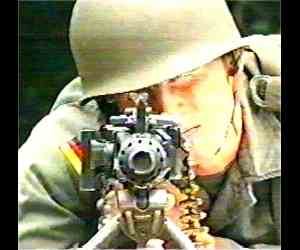
History of the MG42 - The
Predecessor to the MG3
Caliber 7.92mm
Cartridge: 7.92mm x 57mm Mauser
Length: 48 in (1219mm)
Weight : 25.25 lbs. (11.5 kg)
Muzzle Velocity: 2478 ft. (755m) per second
Effective Range: 1100 yds. (1000m)
Rate Of Fire: 1200 rounds/min. (cyclic)
Magazine: 50 round link belt fed
The MG-42 machine gun was
designed to replace the German MG-34. The MG-42
was to be mass produced and to be more rugged
in the field than the hand-crafted MG34 which
demanded more maintenance and care. The result
of these efforts created perhaps the World's
best Machine gun with a unique "Delayed
Blowback" system of firing. Durable, dependable
and possessing an incredible rate of fire made
this weapon the pride of German Infantry and
the scourge of the Allies.
Its distinctive firing sound
of ripping canvas punctuated the Battlefield
and was easily recognizable by Americans because
the MG 42 fired three times as fast as any Machine
gun in the American arsenal.
By 1944 - the German Squad
and its Tactics revolved around the MG-42. The
Squad's main focus in a firefight, was to get
the MG42 up and firing on the Enemy as quickly
as possible, with the rest of the Squad ready
to bring more Ammo to the Gun if need be. In
addition, the Gunner of the Squad's MG-42, was
the Unit's Best and Steadiest Soldier. The MG-42
may be fired from its Bipod (Light MG), on a
Tripod (Medium) or from a Tripod and with a
heavy barrel (Heavy).
The MG42 was an extremely
useful field weapon that was uniquely suited
for modern warfare. It had several unique advantages
over other countries' machine guns, largely
due to its post-WWI development (unlike the
BAR, Vickers, etc.)
The MG42 had the highest rate
of fire of any infantry machine gun during World
War II. In fact the German Infantryman was taught
to conserve ammunition and only employ the high
rate of fire when necessary.
Tripod / Bipod The MG42 was
designed to fit on an Ingenious Tripod system.
This system was designed so as to fit a MG42
with no modifications to the gun, in fact the
Bipod on the MG42 would remain as it "sat"
in the tripod. Because of the Tripod system,
the MG42 can be removed from the tripod and
be used as a LMG.
Because German Fallschirmjagers
(Paratroopers) often lacked supporting weapons
during operations, the FG-42 was developed to
give each individual paratrooper more firepower.
A cross between a light machine gun and an assault
rifle, the gas-operated FG-42 could be fired
Ingeniously Single- Shot with a closed rifle
bolt or Full auto with an open bolt.
The FG 42 also featured a
bipod, an attachable bayonet, and a 20 round
box clip that was fitted above the trigger on
the left side of the weapon. The side location
for the clip however was found to snag on equipment
and to unbalance the gun when it was fired.
Overall, the FG42 was a brilliant
design whose development would lead to the creation
of the MP-44 and assault rifles as they are
known today. Because of the complex nature of
the FG 42, manufacturing the weapon was difficult.
Only 7,000 FG 42s were produced before war's
end.
The FG 42 incorporates many
aspects that were later incorporated into assault
rifles such as the MP44 and more modern examples.
The FG 42 also has some characteristics of pre-machine
guns because the weapon was initially envisioned
as a squad support weapon. After the WWII the
MG42 adapted to the NATO Caliber 7.62mm and
after some changes they became MG3. The MG3
uses the ammo DM DM41 & DM21 and can be
mounted to ;
1. a Bipod (Standard)
2. a Tripod
3. a Anti-Aircraft Tripod
4. a Single mount (SoLa)
5. an Anti-Aircraft Dual mount (ZwiSoLa)
6. or adapted to several Military vehicles (Coaxial
- at the Turret Top / Commander Hatches - such
as FlaMg).
|